
Most Businesses Think They’ve Hired an SEO Agency. They Haven’t.
They’ve hired a vendor who sends monthly reports full of numbers that don’t move the needle. If your website traffic has been “improving” for six months but your phone still isn’t ringing — you’re not alone, and it’s not your fault.
In this post, you’ll learn exactly what separates top SEO service providers from the sea of average agencies, and what red flags to watch for before you write another check.
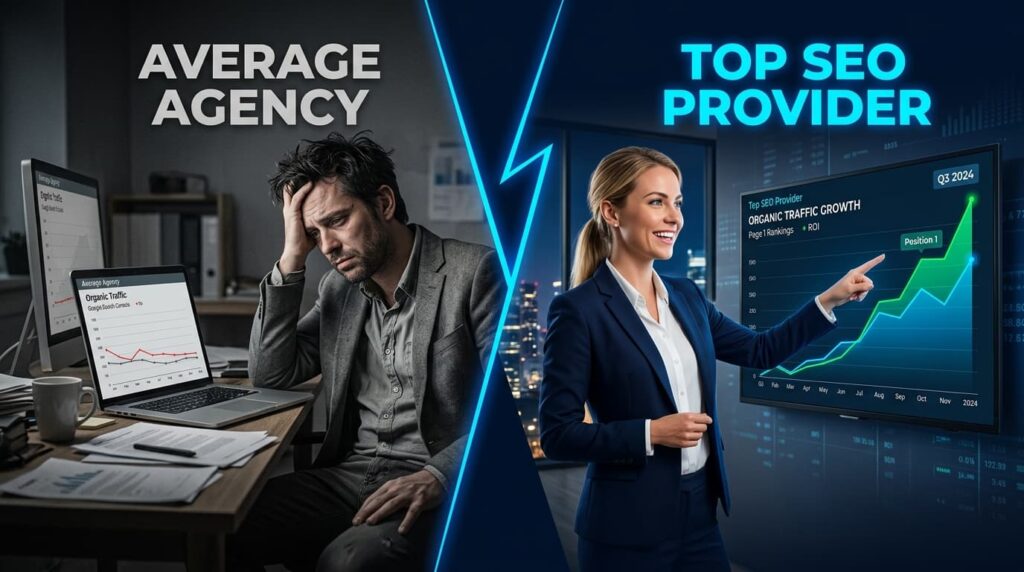
The SEO Industry Has a Transparency Problem
Search Engine Optimization has become one of the most misunderstood services in digital marketing. Because results take time, it’s easy for agencies to hide behind vague language, vanity metrics, and activity reports that look impressive but deliver little.
Here’s the uncomfortable truth: most businesses can’t tell the difference between an agency that’s genuinely growing their organic presence and one that’s just keeping busy.
That gap — between real SEO and performance theater — is where US businesses are losing money every single month.
What Average Agencies Typically Do (And Why It Falls Short)
Most mid-tier agencies offer a standard package: a few blog posts per month, some keyword tracking, and a technical audit that gets filed and forgotten.
This approach fails for a few key reasons:
They chase rankings, not revenue. Getting to page one for a keyword nobody searches is worthless. Average agencies optimize for metrics that look good in reports — impressions, clicks, keyword positions — rather than qualified traffic that converts into actual customers.
They don’t understand your business. Generic SEO ignores your sales cycle, your customer’s buying journey, and what actually makes someone pick up the phone or fill out a contact form.
They’re reactive, not strategic. Google’s algorithm (the system it uses to rank websites) updates constantly. Average agencies scramble to respond. Top SEO service providers anticipate changes because they’ve built strategies on fundamentals that don’t rely on shortcuts.
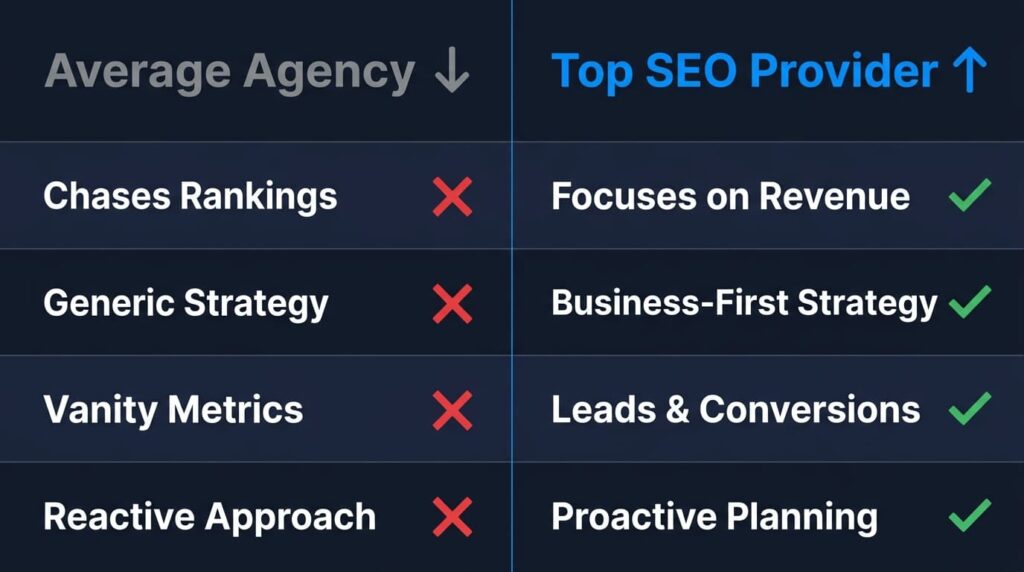
What Top SEO Service Providers Actually Do Differently
The difference isn’t always visible on a proposal. It shows up in results — usually within three to six months.
1. They Start With Business Goals, Not Keyword Lists
Before picking a single keyword, the best agencies ask: What does success look like for you? Is it more demo requests? More foot traffic? Better quality leads from specific industries?
Keyword research (finding the words your customers type into Google) flows from that business goal — not the other way around.
2. They Build Content That Earns Trust
Top-tier SEO is built on content that genuinely answers your customer’s questions better than anyone else does. This is called search intent optimization — matching your content to what people are actually looking for, not just what has high search volume.
An LSI keyword (Latent Semantic Indexing — a fancy way of saying “related terms that Google associates with your topic”) strategy supports this. It means your content covers a topic thoroughly, the way a real expert would.
3. They Think About Technical Health As an Ongoing Process
Website speed, mobile-friendliness, proper indexing (how Google reads and stores your site) — these aren’t one-time fixes. They degrade over time as your website grows. Top agencies treat technical SEO as an ongoing maintenance priority, not a checkbox on the onboarding list.
4. They Tie Reporting to Pipeline, Not Just Traffic
The best agencies show you how organic search is contributing to leads, inquiries, and sales — not just how many people visited your site. If your agency can’t draw a line from SEO to revenue, that’s a problem.
A Real-World Example: What a Shift in Strategy Looks Like
Consider a mid-sized B2B manufacturer in Hyderabad — let’s call them a commercial equipment supplier. They’d been working with a local agency for over a year, steadily climbing rankings for generic industry terms. Traffic was up 40%. But qualified inquiries had barely budged.
When they partnered with an agency that understood intent-driven SEO and organic lead generation, the strategy shifted. Instead of targeting broad category keywords, the new approach focused on high-intent, long-tail keywords (longer, specific search phrases like “industrial LED display supplier for warehouses in India”) combined with landing pages built specifically for decision-makers.
Within five months, qualified inbound leads increased by over 60% — without touching their ad budget. The lesson? Volume of traffic means nothing without intent alignment.
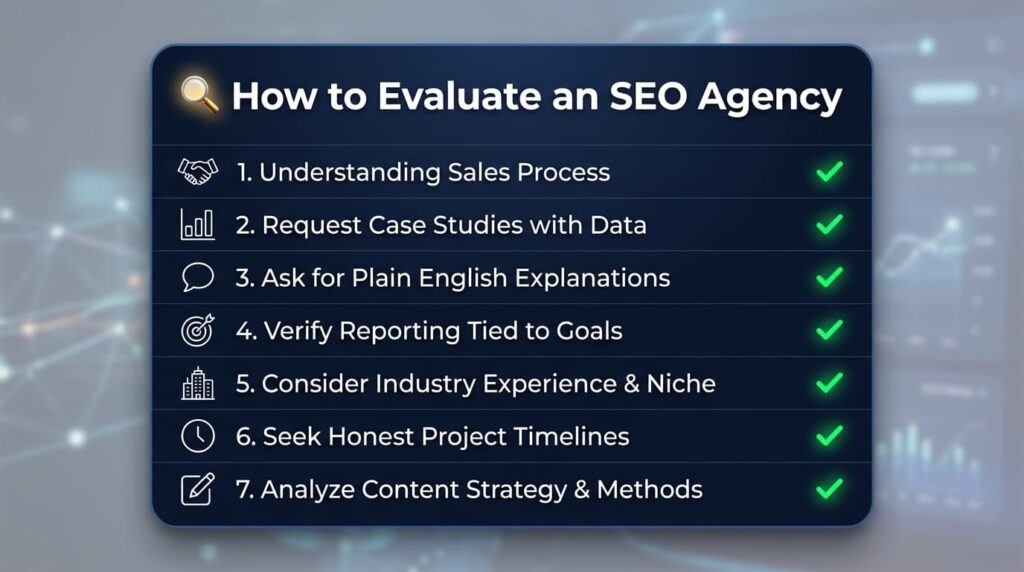
A Quick Checklist: How to Evaluate Any SEO Agency Before You Sign
Use this before your next agency call:
- Do they ask about your sales process and ideal customer before talking about keywords?
- Can they show case studies with actual business outcomes (leads, conversions) — not just traffic charts?
- Do they explain their strategy in plain English, or hide behind jargon?
- Is their reporting tied to goals you actually care about?
- Do they have experience in your industry or with your target market?
- Are they transparent about timelines? (Honest agencies don’t promise page-one rankings in 30 days.)
- Do they proactively discuss content strategy alongside technical SEO?
If you’re getting vague answers on more than two of these, keep looking.
The Bottom Line
The gap between a great SEO agency and an average one isn’t about tools, team size, or fancy dashboards. It’s about strategic thinking, honest communication, and a genuine focus on your business outcomes rather than their own reporting convenience.
Top SEO service providers are out there — but finding them requires knowing the right questions to ask. Now you do.
Want to see what a strategy built around your actual business goals looks like? Explore our SEO services and let’s have a straightforward conversation about what’s possible for your brand.